
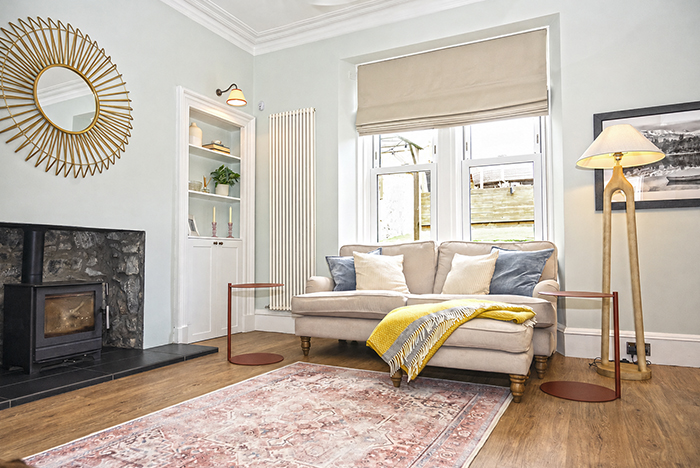
Traditional granite and stone homes across Scotland carry beautiful character: cornicing, deep windowreveals, fireplaces, solid doors and proportions that newer builds rarely match. Many owners protect that character by leaving every wall white, grey or beige for years, worried that colour might damage what makesthe house special. Colour does not erase period features when it is chosen with the property in mind. Usedcorrectly, it draws attention to them.
How colour draws out original features
A deep, warm colour on a wall with original cornicing makes that detail read as intentional, catching shadowand light in a way flat white cannot. A rich green or a warm ochre in a hallway with high ceilings gives asense of scale and quality that beige does not deliver. The most effective approach chooses colours that sit comfortably alongside materials already present in the property: natural stone, original wood, cast ironradiators. Warm neutrals, deep greens, soft rust and layered wood tones work with granite and sandstonebecause they echo the materials the house was built from. It is also worth knowing that historic joinery in Scottish granite homes was traditionally painted in dark tones, not white, so a deep colour on original doors and skirting sits closer to how the house was originally finished than the pale woodwork most owners default to.
Mixing old and new
Combining old and new well comes down to a few consistent techniques. Original joinery, fireplaces andcornicing should carry the most detail and colour intensity in a room, with modern furniture and lighting kept plainer alongside them, so the two eras do not compete for attention. A useful proportion to work towards isroughly four modern pieces for every one strong period piece, enough contemporary furniture to keep a roomfunctional for a busy family, without diluting the character the house already has.
Solving layout without losing original features
Layout is the second challenge in these houses, since older Aberdeen homes were built with smaller,separated rooms and removing walls is not always possible where original features or listed status areinvolved. A rug, a change of flooring, or a low-hung pendant light can zone a room without touching a wall.Storage is best found in eaves and attic space: a run of low cupboards along the sloped wall, with a taller wardrobe where the ceiling is highest, kept plain so it stays in the background, not competing with original detail.
Planning it properly
A Home Colour Consultation looks at a property’s specific rooms, light and existing materials and featurestogether, so the colours recommended work with the granite, the woodwork and the period features already there.
For a fuller renovation, Residential Interior Design covers layout, materials and furniture planning as well, so every decision protects what made the property worth buying.
Contact us here to discuss your property