
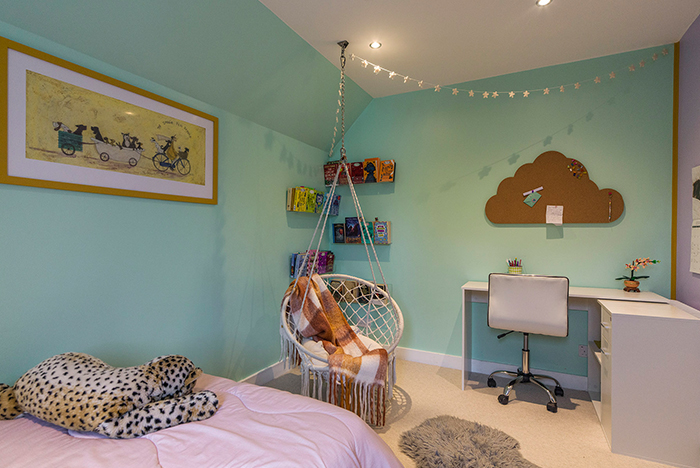
Sensory processing differences are common among autistic people, and the National Autistic Society reports that many experience heightened or reduced sensitivity to sound, light, texture and visual clutter. Colour, lighting and layout function as more than decoration here. Research shows they measurably change howcomfortable someone is, and how well they can concentrate, in their own home or workplace.
What sensory sensitivity means for a room
The National Autistic Society identifies bright or fluorescent lighting, bright sunlight, visually crowded environments and patterned wallpaper or carpet as common triggers for sight-related sensory discomfort.Their guidance on accessible spaces recommends reducing brightness through dimming, and setting aside a quiet area away from the busiest part of a home or building, where noise and light are both lower.
What the research says about colour
A 2022 study in Frontiers in Psychiatry surveyed 87 autistic children aged six to sixteen and their parents on how colour and lighting affected mood and behaviour. Neutral tones and mellow, pastel shades were linked toa settling effect. Bright, bold and intense colours were linked to agitation, irritability and distress, and darker tones were found unsuitable for the same reason.
For children with ADHD, the evidence points more to attention than mood. A study from Bilkent University found children with ADHD made significantly fewer errors on coding and matching tasks when a wall waspainted a different colour to the surface they were working against, such as a whiteboard or desk. The effectcame from contrast between the two surfaces, not either colour used on its own. Visual clutter reducesavailable attention for any child, and the effect is stronger for a child who already finds it harder to filter out competing information.
Lighting
Fluorescent tubes, flickering lights and harsh overhead brightness caused behavioural disturbance and discomfort in autistic children, while natural daylight and dimmable LED lighting supported steadier behaviour.Overhead lighting positioned above eye level is better tolerated than lighting at eye level, since it reducesdirect visual exposure to the light source itself.
Layout and zoning
A quiet zone away from the busiest part of a home or workplace, with reduced light and noise, gives a personsomewhere to retreat to before sensory input becomes too much. The National Autistic Society applies this principle to public buildings, and it works equally well in a family home or an office. Within a bedroom, aseparate, lower stimulation zone for sleep and a more visually active corner for play uses the same contrast principle the Bilkent study found effective for attention, a clear boundary between one function and another.
Applying this properly
Stana Fox, founder of Onyx Interior Design, holds a Diploma in Interior Colour Therapeutics and a Master’s inPedagogy with a specialism in child psychology, alongside personal experience of neurodiversity within herown family. A Home Colour Consultation applies this evidence to a specific room, its light and the person usingit, with a written report covering exact colours, finishes and layout guidance.
Book a Home Colour Consultation here: … for colour and light, or ask about Residential Interior Design for a plan that also covers layout and zoning.
References
- National Autistic Society, “Sensory ” https://www.autism.org.uk/advice-and-guidance/about-autism/sensory -processing
- National Autistic Society, “Accessible “
https://www.autism.org.uk/learn/knowledge-hub/guides-and-resources/accessible-environments
- Frontiers in Psychiatry, “A case study on the effect of light and colors in the built
environment on autistic children’s behavior,” 2022. https://www.frontiersin.org/journals/psychiatry/articles/10.3389/fpsyt.2022.1042641/full
- Bilkent University, “Effects of a colored wall and a colored board on performances of children with attention deficit hyperactivity disorder.”
https://repository .bilkent.edu.tr/items/790a87d8-41d0-4a47-8612-27d1b7471b01
- Psychological Science / Carnegie Mellon University, “Heavily decorated classrooms disrupt attention and learning in young children,” 2014. https://www.psychologicalscience.org/news/releases/heavily -decorated-classrooms-disrupt-attention-and-learning-in-young-children.html