
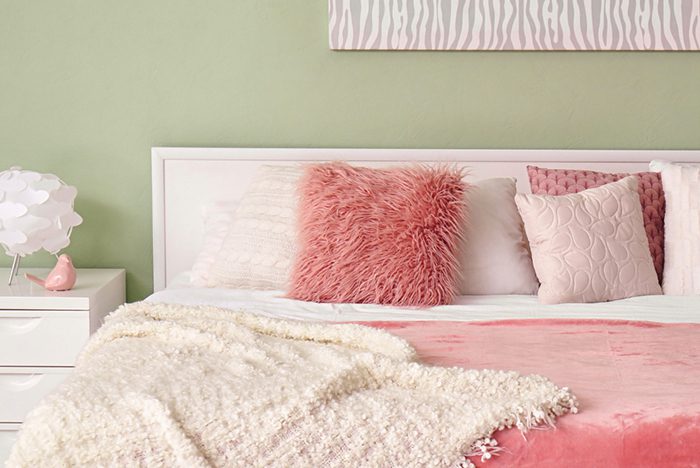
A guest room comes together through the same decisions that shape every other room in the house: colour with a clear direction, materials that hold up to a short stay, layered lighting, and a small set of accessories chosen with a guest in mind. Done well, it stops being the room where spare furniture collects and becomes a space that says the house was ready for someone, not just tidied before they arrived.
Colours that work
Research on bedroom colour and sleep points in a fairly consistent direction. Blue is the shade most often linked to longer average sleep and a lower heart rate, and a soft, muted blue works far better here than a bright or saturated one. Green follows closely, associated in the same research with comfort and a sense of nature indoors, and reads best as a companion tone or on a single wall instead of covering the whole room. White and soft off-white neutrals complete the research-backed shortlist, since a plain, low stimulus background is linked to less mental activity at bedtime than a busy or saturated colour scheme. Red, orange, strong yellow and black sit at the opposite end of that research, associated with higher alertness and a faster pulse, which is not what a guest needs on the first night in an unfamiliar bed. The same psychology carries through into what the room is made of, not only what it is painted
Materials and textures
Linen bedding in a heavier weight than a main bedroom would use copes better with infrequent washing and still looks kept even after months in a cupboard. A waffle cotton throw or a wool blanket folded across the foot of the bed adds warmth without extra bulk in storage. Bouclé or wool on a single armchair or headboard brings texture into a room that otherwise leans on paint and bedding alone. Rattan or wicker, on a blind, a mirror frame or a small chair, sits well against the darker colours above and keeps the room from reading too formal. Oak or walnut furniture, rather than a painted or veneered finish, is worth the investment since guest room furniture gets used rarely and needs to look right for years rather than a season, and a jute or wool rug underfoot finishes the room properly on a cold floor.
Lighting
A guest room needs three light sources working together rather than one central pendant left to do the job alone. A bedside lamp on each side of the bed, fitted with a warm white bulb around 2700 Kelvin, lets a guest read in bed without switching on the main light. A dimmer on the ceiling fitting covers the rest of the room without ever putting someone under bright light first thing in the morning or last thing at night. Blackout blinds or a set of fully lined curtains matter more in a guest room than almost anywhere else in the house, since a guest sleeping somewhere unfamiliar is more sensitive to early light through thin curtains than they would be in their own bedroom.
The extra details
A pair of cushions in a texture that contrasts with the bedding, such as bouclé against linen or velvet against cotton, gives the bed a finished look without adding extra colour. A vase of fresh or dried flowers on the dresser or bedside table brings a natural note into the room and reads well when the same flower or foliage is used downstairs too. A piece of art, whether a framed print or a small original, gives the eye somewhere to rest and stops a plain wall from reading as unfinished. A mirror, propped or hung, adds depth to a small room and reflects whatever light already reaches it. A tray on the dresser, holding a scent diffuser or a small stack of books, pulls loose objects together.
When the spare room does double duty
Many spare rooms also carry a desk, which raises the real design question of how to stop a home office from dominating a room that needs to read as a bedroom the moment a guest arrives. A daybed, a wall-mounted Murphy bed or a proper sofa bed with real support solves this far better than a fold-out mattress pulled from a cupboard. The colour and lighting choices above do the rest of the work, since a room that already reads as considered needs less effort to convince a guest it was built for them and not simply repurposed for the weekend.A guest room finished beautifully says something about the whole house. It is often the space visiting family remember most clearly after a weekend stay, simply because it is the one room designed entirely around someone else’s comfort rather than the household’s daily routine.The ONYX COLOUR CONSULTATION covers this decision directly: choosing a sleep-friendly colour palette for a spare room, matched to the materials, lighting and finishes already in the space, with a
written report setting out precise colours, codes and finishes within 48 hours. For a full room design, RESIDENTIAL INTERIOR DESIGN covers layout, furniture and lighting as part of a complete plan, so a spare room works as a genuine guest room, not an afterthought. Book your free discovery call here: Discovery Call – Onyx Interior Design Aberdeen, to discuss your colour or renovation plans.
References
1. What Color Helps You Sleep?, Sleep Foundation
2. Best Bedroom Colors for Sleep: Is Anything Proven to Work?, Healthline